Published · 4 min read
Passage Retrievability: Paragraphs That Survive Alone
Agent readiness
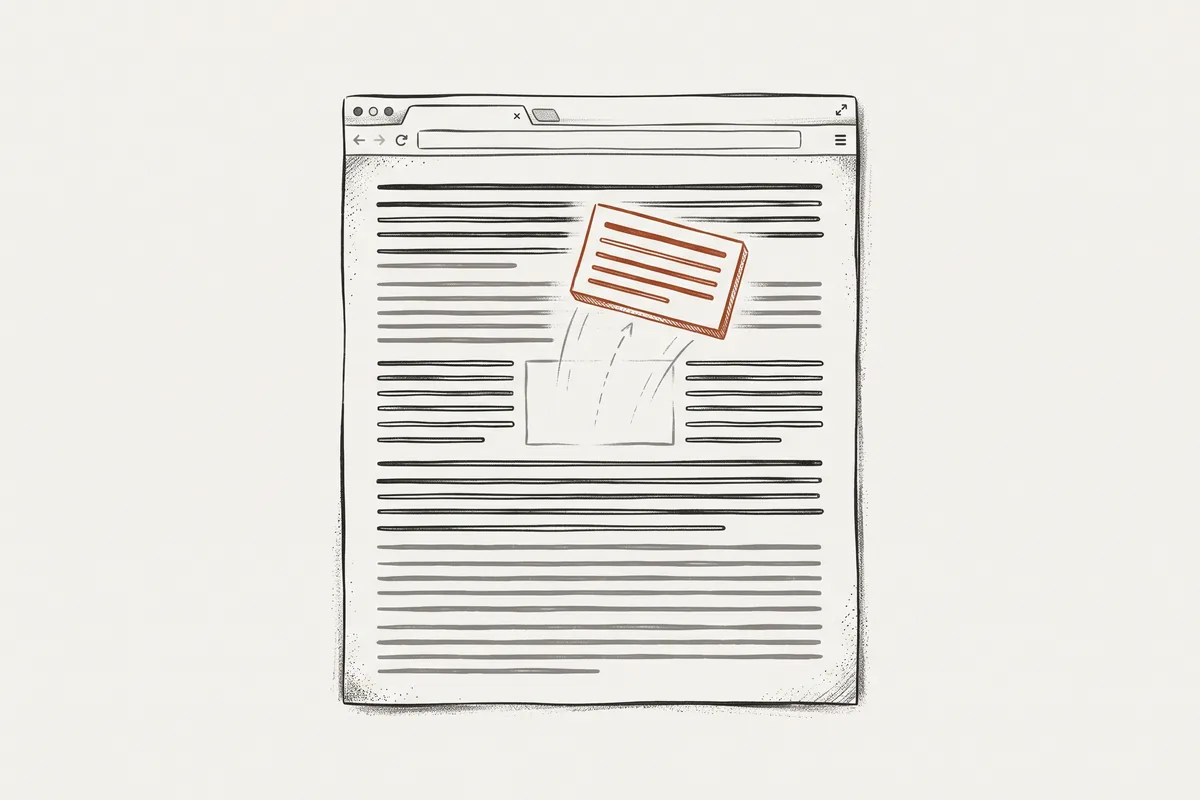
Passage retrievability is how well the paragraphs of a page can be lifted out one at a time by a search or AI engine and still make sense. A retrievable passage states its point in its first sentence, names its subject instead of leaning on "it" or "this", and carries the facts it needs.
Newspapers solved part of this with the inverted pyramid: the most important facts go first, so an editor can cut the story from the bottom and what is left still works. The usual origin story credits Civil War telegraph operators sending the essentials first in case the line went down. Horst Pöttker's analysis of the New York Herald and the New York Times (Journalism Studies, 2003) found the form became commonplace only about two decades after the Civil War, and argued it spread as editors worked to make news easier to understand.
Why Passage Retrievability Matters for B2B SaaS
Product pages get praised for flowing: the plan introduced in one paragraph, the price two paragraphs later. Lift the third paragraph out and it says "this includes unlimited seats", and nobody can tell what "this" is. One content marketer watched content that did well in traditional search "fall apart on AI overviews because the paragraphs were written to flow together, not to stand alone" (r/content_marketing, 3 June 2026).
The pyramid's guarantee is also narrower than it sounds. It protects the top of a story from a cut at the bottom, while an engine answering a buyer's question lifts from wherever the answer sits, which may be the middle. Google has ranked individual passages as well as whole pages since 2020. The rule only transfers if every paragraph becomes its own small pyramid.
Monitoring can show that your pricing page went unquoted for a prompt (what trackers measure). It does not show which paragraph an engine considered and dropped, or why: for example, that the price sat in a sentence whose subject was "this" while the plan name lived in a heading two blocks up, which only the stand-alone test shows you.
How AI Engines Quote a Page, and How to Measure Passage Retrievability
Copy a paragraph from your page into a blank document and read it cold. It passes if its first sentence states a fact and every number still carries its unit and subject. Could a stranger tell which product, plan or claim it is about? Count the paragraphs that pass.
Our own measurement is weaker than the test. The answer-first check in a Nudgent audit reads only the first sentence of each passage. It fails a sentence that ends in a question mark or opens with a hook word such as "Imagine", and passes one with a plain verb like "is" or "costs" in its first 25 words. So "It is the only plan that includes SSO" passes the check and still fails the stand-alone test, because "it" points at nothing. We treat the count as a pointer to paragraphs worth reading alone.
Passage Retrievability vs Extractability
Agent extractability is a separate question, whether the facts sit in machine-readable text at all. A page can have every fact in plain text and still not have one paragraph that survives being lifted.
How to Improve It with Answer-First Paragraphs
Lead each paragraph with its point. Repeat the product or plan name where ordinary prose would use a pronoun, keep each number next to the thing it counts, and phrase headings as a buyer's question.
One tension we have not settled: a page written entirely as self-contained chunks can read like a stack of index cards to a person.
Take your pricing page and lift its paragraphs out one at a time, reading each as a stranger would. How many would you get through before one failed, and would that be the one with the price in it?
Related Terms
Frequently asked questions
01What is passage retrievability?
Passage retrievability is how well a single paragraph of a page still makes sense when a search or AI engine lifts it out on its own.
02How does passage retrievability differ from extractability?
Extractability asks whether the facts are in machine-readable text at all. Passage retrievability asks whether one paragraph of that text still makes sense away from its neighbours. A page can pass the first and fail the second.
03What is a good passage retrievability score?
There is no public benchmark. Compare the same page before and after a rewrite, and trust a paragraph read on its own over the number.